01
Choose the vintage detail that matters
Vintage-inspired wedding invitations can feel formal, romantic or relaxed. Decide whether the mood comes from lettering, illustration or a border before adding more decoration. Mixing several ornate elements can make the information harder to find and may not suit the template you are editing.
- For a classic direction, focus on a clear type hierarchy.
- For a venue-led direction, give the drawing space around it.
- For a romantic direction, use script sparingly and keep location details readable.
02
Use formal wording that fits your hosts
Traditional wording often begins with a hosting line, but there is no reason to name hosts who are not part of your plans. Use “Together with their families” when it fits, or begin with the couple’s names. A formal tone should not obscure the date, time or whether guests are invited to a ceremony, reception or both.
- Check preferred names and spellings with everyone named on the card.
- Choose one consistent style for the date and time.
- Use reception-only wording when that is the event guests will attend.
03
Bring a historic venue into the design honestly
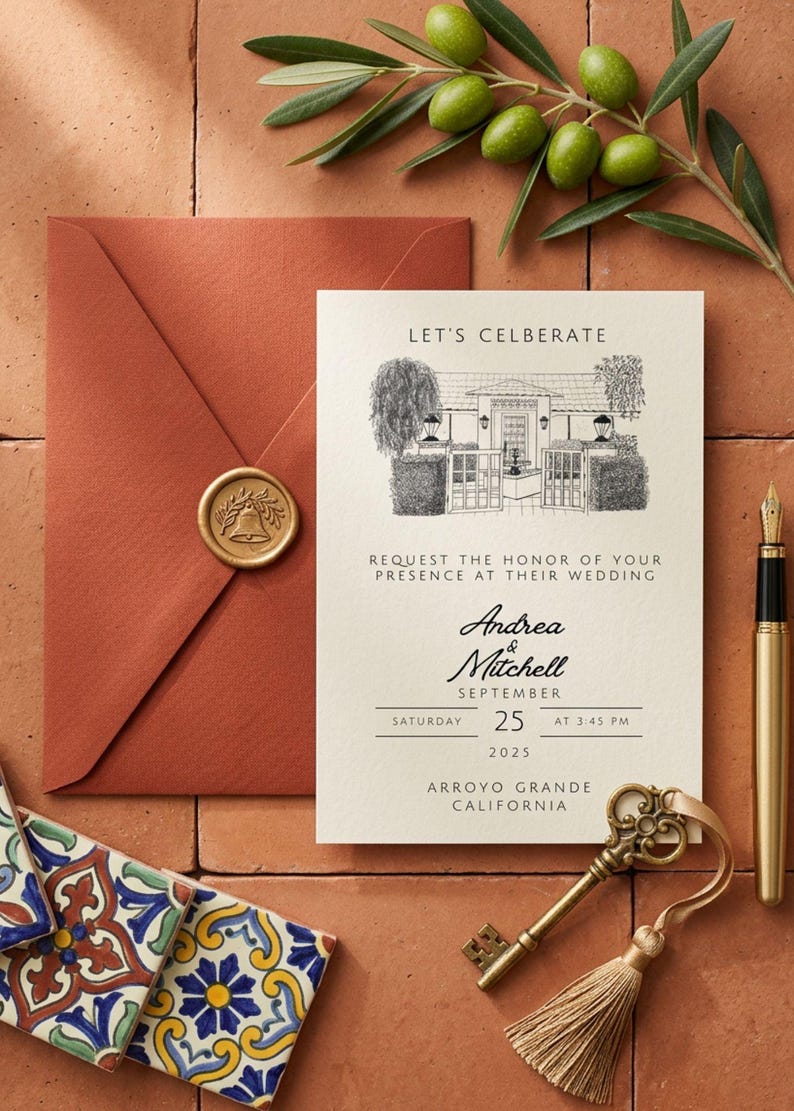
A building sketch can connect stationery to an estate, garden setting or architectural venue. The current template depicts the venue shown in its photos, not any building you name in the wording. For a different drawing, share a reference and ask the studio to confirm scope, revisions and timing.
- Check the gallery to see the illustration actually included.
- Treat a new venue portrait as a separate request.
- Ask about matching details cards or RSVP cards before planning a suite around them.
04
Check fine lines, script and paper together
Small flourishes and thin strokes are best judged at the finished size. Textured or warm-toned paper may change the appearance of the artwork and type, so ask your printer about a suitable file and order a proof. A digital template purchase does not include specialty printing, envelopes or a physical mailing.
- Read every scripted name without enlarging the proof.
- Check contrast between the ink and your chosen paper.
- Verify card size, envelope fit and the assembled mailing before the full order.
Make it your own
A starting point for your invitation wording
Replace the placeholders with your confirmed details. Adjust the hosting line and tone to fit your celebration.
Together with their families[Name] and [Name]request the pleasure of your companyat the celebration of their marriage[Day, date] at [time][Venue name], [city]Reception to followMore wedding invitation wording guidance
Final pass
Before you download or print
- Choose one vintage design feature to lead.
- Check the hosting line and preferred names.
- Make scripted text readable at final size.
- Confirm whether the artwork is existing or custom.
- Review a proof on your chosen paper.
Questions before choosing
Vintage wedding invitations: FAQs
What makes a wedding invitation vintage-inspired?
Classic lettering, a venue illustration, a restrained border or a softer paper palette can create a vintage direction. Choose details that fit the event and keep the essential wording clear.
Do vintage wedding invitations need formal wording?
No. You can use a vintage design with conversational wording. Match the hosting line and tone to your plans while making the event, date, time and venue explicit.
Can I use the hand-sketched template for a historic venue wedding?
It may suit your style, but its drawing is the existing illustration shown in the gallery. A portrait of your specific historic venue is a separate custom request.
Does a vintage wedding template include specialty paper or printing?
The current shop products are digital designs. Paper, printing, envelopes and specialty finishes are arranged separately with your chosen printer.